The right opening for a 1000-rated player is almost certainly wrong for a 2200 player — and vice versa. At 1000, a good opening is one that forgives mistakes and teaches principles. At 2200, a good opening is one that gives positions its player understands more deeply than the opponent, even if it costs some risk.
That's why this list isn't arranged as "the 10 best openings" in general, but as the 10 openings that fit best at each rating step: 1000, 1500, 1800, 2000, 2200, 2400, and 2600 and above. Each opening comes with its reason, its basic moves, and the sign that you're ready to move on to the next one. If you don't know your rapid rating yet, play ten games in Katuranga's Online Duel — the system will find your number.
Before the list, one warning: don't jump to openings meant for a rating above yours. The Najdorf in the hands of a 1200 player isn't a weapon, it's a collection of sharp positions they don't understand. Openings for higher levels aren't "better", only more demanding.
Rating 1000 — learn principles, not theory
At this level games are decided by hanging pieces and two-move tactics, not openings. The opening has only one job: get your pieces to sensible squares without accidents.
1. Italian Game (1.e4 e5 2.Nf3 Nc6 3.Bc4)
The most instructive opening there is. Center, development, castling — the three principles a beginner needs, each represented by a single move. The c4 bishop gives a clear target (f7), the f3 knight controls the center, and its quiet version (d3, c3, O-O) is almost impossible to lose quickly.
Why it fits at 1000: the resulting positions are simple and open; an opponent's mistakes can be punished right away with easy-to-see tactics. A full guide is in the best openings for beginners.
As Black: 1...e5 against 1.e4, and 1...d5 2.c4 e6 (Queen's Gambit Declined) against 1.d4.
Ready to move up when: you castle before move 10 in more than 90 percent of games, and you no longer lose free pieces in the opening.
Rating 1500 — a solid system and a clear plan
At 1500, opponents no longer hand out free pieces easily. You need an opening that gives a middlegame plan — not just a healthy position, but knowing what to do next.
2. London System (1.d4 d5 2.Bf4)
The same structure against anything, a consistent attacking plan (Ne5, Qf3, sometimes h4-h5), and almost no sharp theory to memorize. The London teaches something 1500 players haven't mastered yet: playing according to a plan, not according to reactions.
Why it fits at 1500: you can spend your thinking energy on the middlegame, not on remembering theory. And 1500 opponents who play aggressively against the London usually overreach and can be punished.
3. Vienna Game (1.e4 e5 2.Nc3)
For those who prefer attacking. The Vienna looks like the Italian in a different order, but the f4 threat (the Vienna Gambit) gives much sharper play against unprepared opponents — and at 1500, almost nobody is prepared.
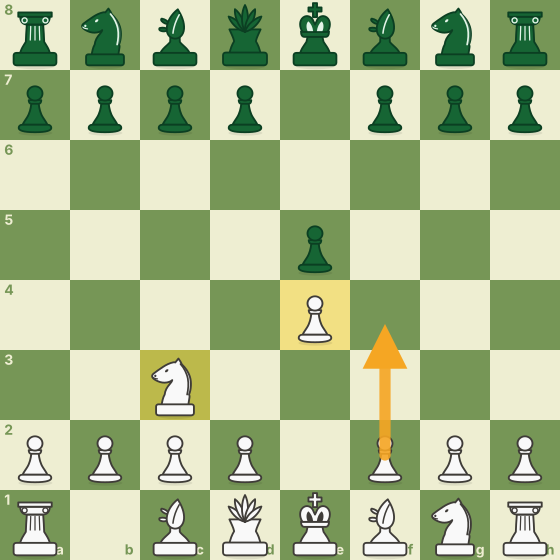
Why it fits at 1500: the positions are sharp but the theory is short. Three or four learned traps are enough to win many games, and when the opponent plays correctly, the position stays healthy.
As Black at 1500: the Caro-Kann (1.e4 c6) for those who like solidity, or stay with 1...e5. Against 1.d4, add the Slav (1...d5 2.c4 c6) as an alternative to the QGD.
Ready to move up when: you can explain your opening's middlegame plan in two sentences, and your average accuracy in Analysis is above 75 percent.
Rating 1800 — start playing for an advantage
At 1800, players start understanding pawn structures, weak squares, and good vs bad pieces. The opening now has to give positions that suit your style and offer a real advantage if the opponent isn't precise.
4. Ruy Lopez / Spanish (1.e4 e5 2.Nf3 Nc6 3.Bb5)
An opening played at every level from club to world championship, for a reason: it teaches long-term pressure. The b5 bishop threatens to damage Black's pawn structure, the center is held with d3 or d4 as needed, and play develops slowly with c3, d4, Nbd2-f1-g3 — the classic Spanish maneuver.
Why it fits at 1800: at this level you're patient enough to play positions whose advantage only shows around move 25. The Ruy Lopez is a strategy course disguised as an opening.
5. Sicilian Defense (1.e4 c5) — as Black
From 1800 up, 1...e5 starts to feel too passive for those who want to win as Black. The Sicilian is the most ambitious answer to 1.e4: asymmetrical positions, Black gets an extra central pawn after ...cxd4, and queenside play with a clear plan.
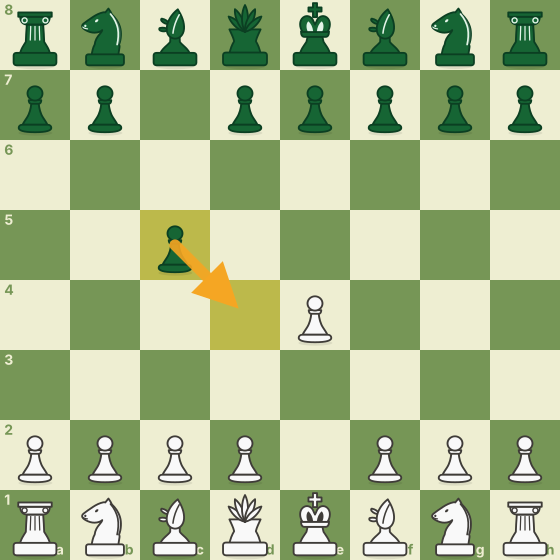
Start with systematic lines, not the sharpest: the Sicilian Kan or Taimanov (with ...e6 and ...a6), or the Accelerated Dragon (with ...g6). The Najdorf and the classical Dragon wait on the next step.
Ready to move up when: you can read pawn structures — you know where your opponent's weak pawns are and how to attack them — and you consistently win endgames with small advantages.
Rating 2000 — a complete, double-edged repertoire
At 2000, opponents know theory. You need openings that give rich positions that are hard for the opponent to play, and you need answers to almost every main line.
6. Queen's Gambit (1.d4 d5 2.c4) — as White
The most classical opening for 1.d4, and at this level you're strong enough to exploit its small advantages. Against the QGD, the Exchange Variation with the minority attack (b4-b5) is a plan you must master. Against the Slav and Semi-Slav, positions are sharper and require real theory.
Why it fits at 2000: 2000 players start to value space advantages and positional pressure. The Queen's Gambit gives both without big risks.
7. King's Indian Defense (1.d4 Nf6 2.c4 g6 3.Nc3 Bg7 4.e4 d6) — as Black
Against 1.d4, the King's Indian is the choice for those who want to win. Black lets White build a big center, then attacks it with ...e5 and a kingside attack that can be deadly. The risk is real — White has a clear queenside plan — but the reward is positions its player understands and the opponent doesn't.
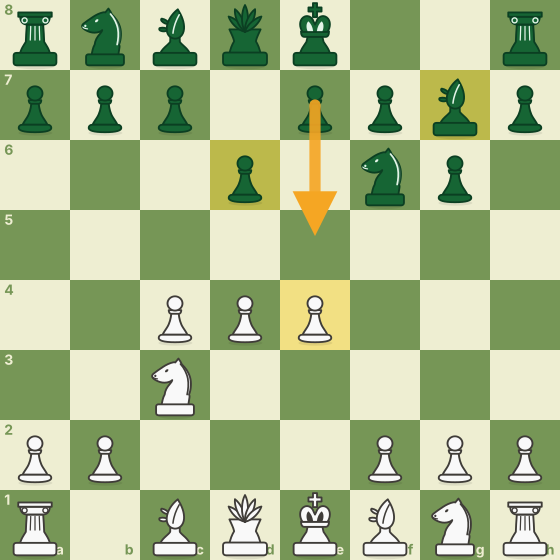
Why it fits at 2000: it requires a deep understanding of plans, and 2000 players have the strategic foundation for it. Below 1800, the King's Indian usually just gives a cramped position they don't know what to do with.
Ready to move up when: you have a written repertoire for all of your opponents' main lines up to moves 12–15, and you've won a game purely from opening preparation.
Rating 2200 — specialization and preparation
At 2200 and above — candidate master level — the opening is a personal weapon. You no longer choose what's "best in general", but what suits your style best and makes your opponents most uncomfortable.
8. Sicilian Najdorf (1.e4 c5 2.Nf3 d6 3.d4 cxd4 4.Nxd4 Nf6 5.Nc3 a6)
The opening of choice for Fischer and Kasparov, and to this day the most ambitious answer to 1.e4. The seemingly minor 5...a6 prepares ...e5 and ...b5, prevents Nb5 and Bb5+, and gives Black enormous flexibility.
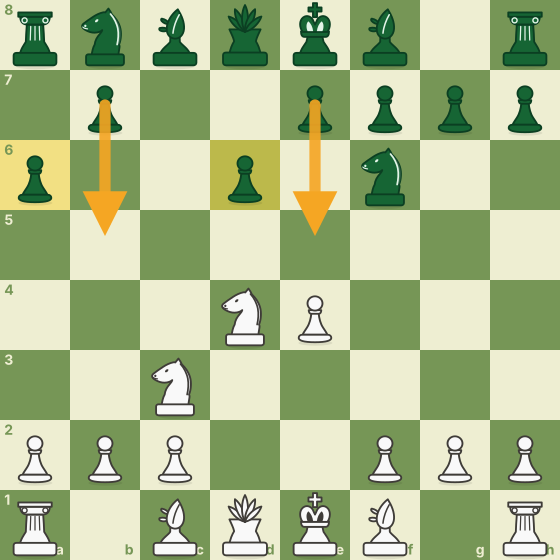
Why it fits at 2200: the Najdorf requires deep theoretical memory and high positional understanding, both at once. Below this level one of them is usually missing, and a Najdorf without either is a fast way to lose in 25 moves.
As White at 2200: pick one system against the Sicilian and master it completely — the English Attack (Be3, f3, Qd2, g4) is a modern choice with a clear plan; 6.Bg5 is sharper; 6.Be2 is more positional. Don't try to master all of them.
Rating 2400 — the opening as a strategic tool
Master level. Openings are now chosen based on specific opponents and tournament needs: need to win with Black? Need a safe draw with White in the last round? The repertoire at this level branches out.
9. Catalan (1.d4 Nf6 2.c4 e6 3.g3 d5 4.Bg2)
A favorite of many modern elite players — Kramnik, Carlsen, Ding — because it gives long-term pressure without risk: the g2 bishop presses the long diagonal, the c4 pawn is often temporarily sacrificed for activity, and Black must play very accurately for dozens of moves to equalize.
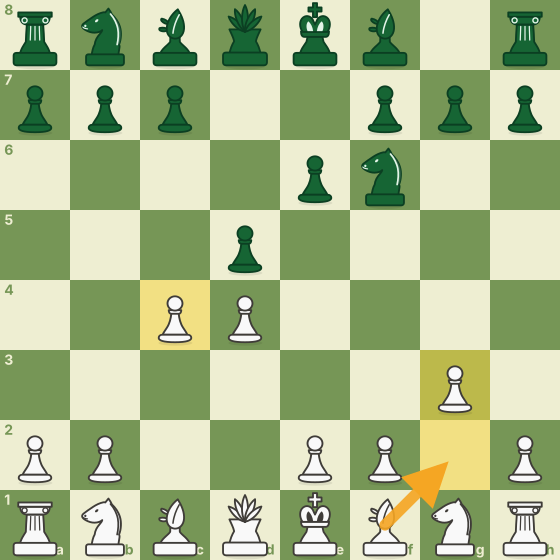
Why it fits at 2400: the Catalan's advantage is small and subtle; only players whose endgame technique and positional understanding are very mature can turn it into points. At lower levels, that advantage evaporates before move 30.
Rating 2600 and above — where theory is written
At the super-grandmaster level, there's no "best opening". Every major opening has been analysed by engines to absurd depths, and what makes the difference is the novelty — a move never played before — and the ability to play positions the engine calls equal but humans find difficult.
10. The Berlin Defense (1.e4 e5 2.Nf3 Nc6 3.Bb5 Nf6) and "anti-theory" defenses
Since Kramnik used it to beat Kasparov in 2000, the Berlin has become a symbol of elite-level openings: Black neutralizes 1.e4 early, entering a queenless endgame (the Berlin Wall) that's theoretically balanced but demands extraordinary technique. Here the winner isn't the one who memorized more, but the one who understands endgames better.
On the same step stand the Petroff Defense (1.e4 e5 2.Nf3 Nf6) and the Marshall Attack in the Ruy Lopez — all choices that change the question from "who knows more theory" to "who is better in balanced positions".
Why it fits at 2600+: because at this level everyone knows theory. The advantage comes from engine preparation before the game and from the ability to defend perfectly for hours. For those of us who aren't super-GMs, the lesson from this level is just one: the opening never wins a game on its own — not even at the top.
Summary table: openings by rating
For those who want to see the whole ladder at once:
- 1000 — White: Italian Game. Black: 1...e5 and the Queen's Gambit Declined. Focus: principles, not theory.
- 1500 — White: London System or Vienna Game. Black: Caro-Kann and Slav. Focus: a middlegame plan.
- 1800 — White: Ruy Lopez. Black: Sicilian (Kan/Taimanov/Accelerated Dragon). Focus: pawn structure and small advantages.
- 2000 — White: Queen's Gambit. Black: King's Indian. Focus: a complete repertoire up to moves 12–15.
- 2200 — Black: Sicilian Najdorf. White: one fully mastered anti-Sicilian system. Focus: deep theory + positional understanding.
- 2400 — White: Catalan. Focus: subtle pressure turned into points through technique.
- 2600+ — Black: Berlin, Petroff, Marshall. Focus: novelties and perfect defense.
Notice that the Black and White entries alternate: not because each level needs only one color, but because the opening that marks the step up alternates in color. At 1800 what changes is how you play Black (the Sicilian); at 2000, how you play White (the real Queen's Gambit, not the London); at 2200, Black again (the Najdorf). Your complete repertoire at each level of course includes both.
How to read this list correctly
A few notes so the list above isn't misunderstood:
Rating numbers are entry points, not fences. A 1500 player may study the Ruy Lopez; a 2000 player may keep playing the London if it works. What matters isn't "which opening for which rating", but whether you understand the positions better than your opponents.
Only move up a step once the step below is mastered. The "ready to move up" signs in each section aren't decoration. If you don't castle on time consistently yet, the Sicilian won't help you.
One mastered opening is worth more than five you merely know. At every level, the players who win are usually specialists — who have played the same opening hundreds of times and know every trap in it.
Openings for Black matter more than for White above 1800. As White you choose; as Black you need answers to 1.e4, 1.d4, 1.c4, and 1.Nf3. Build your Black repertoire first.
How to study openings at each level
The study method also differs by rating:
- 1000–1500: learn the first 6–8 moves with their reasons. The rest is principles. Use Explore to see the most common replies and their result percentages.
- 1500–1800: learn your opening's middlegame plans — where the minor pieces go, which pawns advance, which side you attack on. Watch master games with the same opening in Master Games.
- 1800–2200: build a written repertoire file. For each main line of your opponents: moves up to 12–15, ideas, and one model game. Update it after every game that exposes a hole.
- 2200 and above: prepare with an engine, look for novelties, and study lines to depth 20+. At this level the opening is a research project, not memorization.
At every level there's one shared habit: review the first 10–15 moves of every game in Analysis. If the engine marks move 9 as an inaccuracy three games in a row, that's the hole in your repertoire — and it's the only honest way to find it.
The most common opening-choice mistakes
Before closing, three recurring wrong patterns in the games Katuranga players review:
- Copying idols instead of measuring yourself. A 1300 player plays the Najdorf because they watched Kasparov, then loses in 22 moves to a g4-g5 attack they don't understand. What they needed was the Italian Game, not the Najdorf.
- Collecting openings. Five openings as White, seven as Black, none played more than 30 games. The result: every game feels like a new opening, and no pattern ever settles.
- Changing openings after a loss. Losses almost always come from move 20 onward, not from the opening. Switching openings after one loss throws away all the experience already built up in it.
Closing
Ten openings, seven rating steps. From the Italian Game that forgives everything to the Berlin that forgives nothing. If there's one common thread: the right opening is the one that fits your understanding today, not the one your idol plays.
Play the one for your level. Master it until the "ready to move up" signs are met. Then climb one step — not three. Your rating will follow, and the openings you leave behind won't be wasted: every structure you've ever understood stays yours, in whatever opening you play next.
Frequently asked questions
What's the best opening for a 1000 rating?
The Italian Game (1.e4 e5 2.Nf3 Nc6 3.Bc4) as White, because every move teaches a principle: take the center, develop the minor pieces, castle. At this rating games are decided by hanging pieces, not theory, so a simple, forgiving opening is best.
What's the best opening for a 1500 rating?
The London System for those who like solid positions with a clear plan, or the Vienna Game for those who like to attack. Both give a middlegame plan without long theory, which fits a level where opponents no longer hand out free pieces easily.
When can I start playing the Sicilian?
Around an 1800 rating, starting with systematic lines like the Kan, Taimanov, or Accelerated Dragon. The Najdorf is better postponed until around 2200 because it demands deep theoretical memory and high positional understanding at the same time.
Do I have to change openings when my rating goes up?
Not necessarily. The ratings in this list are entry points, not limits. Change openings only if analysis shows you repeatedly leave the opening with bad positions, or the style really doesn't suit you. One mastered opening is always better than five half-known ones.
What openings do 2600+ grandmasters play?
Almost every major opening, but the standouts are defenses that neutralize early like the Berlin Defense and the Petroff, and systems that apply pressure without risk like the Catalan. At that level everyone knows theory, so what decides is engine preparation and the ability to play balanced positions.
Read also
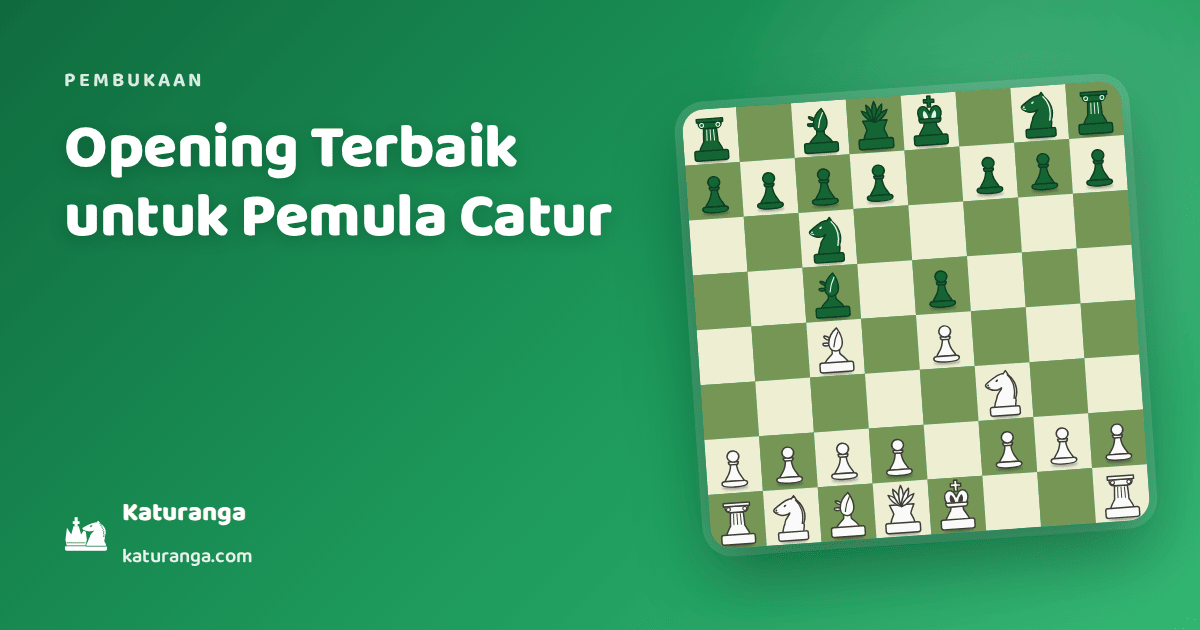
The Best Chess Openings for Beginners: 5 Openings to Master First
Beginners don't need 20 openings — just one as White and two as Black whose ideas they can understand. Here are the five best openings for beginners — the Italian Game, the London System, and safe answers to 1.e4 and 1.d4 — complete with moves, ideas, and traps.
Cara Jadi Grandmaster Catur: Tangga Gelar FIDE, Syarat Norma, dan Berapa Lama Sebenarnya
Penjelasan lengkap tangga gelar catur resmi — CM, FM, IM, GM dan gelar putri — syarat rating dan norma, cara turnamen dihitung, berapa lama jalannya, serta jalur realistis untuk pemain Indonesia yang mulai dari nol.
Kenapa Kamu Selalu Kalah Main Catur? 8 Penyebab Paling Umum (dan Obatnya)
Bukan karena kamu bodoh, bukan karena lawan pakai mesin. Delapan penyebab kekalahan yang benar-benar sering terjadi di catur amatir — bidak gantung, buru-buru, main terlalu banyak, sampai kebiasaan menyalahkan koneksi — lengkap dengan obat yang bisa dicoba hari ini.
Try it on the board
Reading alone doesn't raise your rating. Play one game against a bot, then review it — Katuranga marks your brilliant moves, mistakes, and blunders with Stockfish.