Almost everyone who types "how to improve chess elo rating" into Google has the same story: they've played hundreds of games, their rating goes up and down around the same number, and they're starting to suspect their ability has simply hit a ceiling there. This article was written to refute that suspicion. A stalled rating is almost never caused by a talent limit — it's caused by the wrong way of training, and the way you train can be changed today.
This guide is long, on purpose. What you need isn't ten quick tips, but an understanding of why rating moves the way it does, followed by a routine you can run every day. We start with the number itself.
What is an Elo rating, really?
Elo is a rating system created by Arpad Elo, a Hungarian-American physics professor, and used by FIDE since 1970. The idea is simple: a rating isn't a measure of how smart you are, but an estimate of how often you win against people with a given rating.
If your rating is 1200 and your opponent's is 1200, the system estimates a 50 percent chance of winning. If your opponent is 1400, your chance drops to about 24 percent. If your opponent is 1600, it's only about 9 percent. Every 400-point gap means roughly ten times smaller winning chances.
This leads to consequences players rarely realize:
- Beating weaker opponents gives few points, because the system already "expects" you to win.
- Losing to stronger opponents costs only a few points, because the system already expects you to lose.
- What moves rating the most are unexpected results: losing to someone weaker, or beating someone stronger.
Chess.com uses the Glicko-2 system, not pure Elo, but the principle is the same, with one important addition: a number called rating deviation (RD) that states how confident the system is about your rating. New accounts have a large RD, so the rating jumps 50–100 points per game. After dozens of games, the RD shrinks and the jumps become 5–10 points. That's why new accounts' ratings "rise fast then suddenly slow down" — it's not your ability that stopped, it's the system becoming confident.
Why ratings stall: the three real causes
Before talking about how to climb, be honest about why you stopped. From thousands of games analysed on Katuranga, the losses of players below 1500 almost always fall into one of the following three things.
1. Hanging pieces and one- or two-move tactics
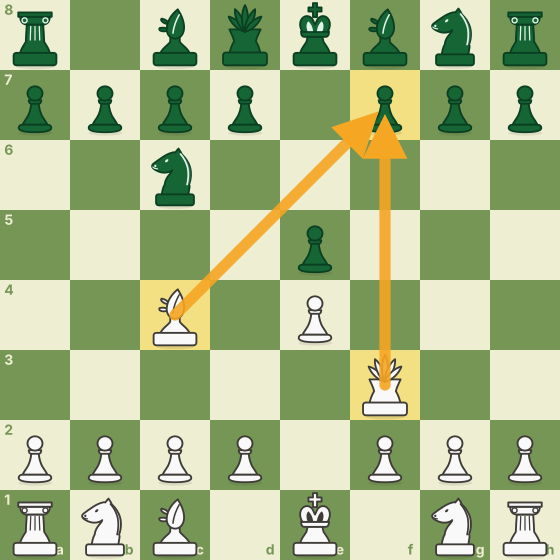
This is cause number one, far ahead of the rest. A "hanging" piece is one that isn't defended and can be captured for free. At 800–1200, more than half of all games are decided by who gives away a free piece first — not by the opening, not by strategy.
2. Playing too fast
Bullet (1 minute) and fast blitz (3 minutes) are fun, but they teach nothing to players who don't have patterns in their heads yet. You just repeat the same mistakes at higher speed. Players whose rating is stuck usually have hundreds of bullet games and almost no rapid games.
3. Never reviewing your own games
This is the saddest one: people lose, close the board, and immediately click "New Game". A loss that isn't reviewed is a lesson paid for dearly and then thrown away. If you change only one habit after reading this article, change this one.
Step 1: Choose the right time control
The time control is the first decision, and often the wrong one.
To raise your rating, play 10+0 or 15+10 rapid. The reason isn't that "rapid is more respectable", but that in rapid you have enough time to think properly — checking whether your pieces are hanging, whether your opponent is threatening something, whether there's a tactic. That thinking habit is what you later carry into blitz. The reverse never happens: nobody learns to think by playing bullet.
The practical rules:
- Below 1200: rapid only. Blitz occasionally for fun is fine, but don't make it the place to "raise your rating".
- 1200–1600: rapid stays the main focus, 5+3 blitz as a change of pace to train quick decisions.
- Above 1600: blitz starts to help sharpen openings and intuition, because the basic patterns are already there.
One more: don't play when you're tired, angry, or have just lost three times in a row. That state is called tilt, and tilt is the number one rating killer at every level. Three losses in a row are a signal to stop, not to "get revenge".
Step 2: The three-question rule before every move
This is the single habit with the biggest impact for players below 1500. Before touching a piece, ask three things:
- What did my opponent just threaten? Your opponent's last move always has a purpose. First look for your pieces that can be captured, checks that can be given, and forks that could appear.
- Does my move leave a piece undefended? After thinking about your move, picture the position, then check: is there a piece that's now unguarded?
- Is there a better check, capture, or threat? The order matters: checks first, captures second, threats third. Most tactics are hidden among these three kinds of moves.
It sounds slow. It is slow in the first week. But after two hundred rapid games with this habit, the three-question check happens automatically in two seconds — and your free-piece blunders drop drastically. That alone is enough to get almost anyone past 1200.
Step 3: Train tactics every day, but the right way
Everyone knows tactics matter. What's rarely discussed is how to train them, and this is where most people waste time.
The wrong way
Solving 50 puzzles in 15 minutes, guessing, pressing the first move that looks right, then looking at the answer if wrong. This trains guessing, not calculating.
The right way
- Few but thorough. Five to ten puzzles a day, each calculated to the end before touching the first move. If you haven't seen the whole variation through to the end, don't move.
- Puzzles around your rating, not far above it. Puzzles that are too hard teach frustration; puzzles around your rating teach patterns.
- After getting one wrong, don't move straight on. Go back to the starting position, see why your move was wrong and why the answer is right. Three puzzles you truly understand are worth more than thirty you skipped through.
- Repeat the puzzles you got wrong the next day. New patterns enter long-term memory through repetition, not volume.
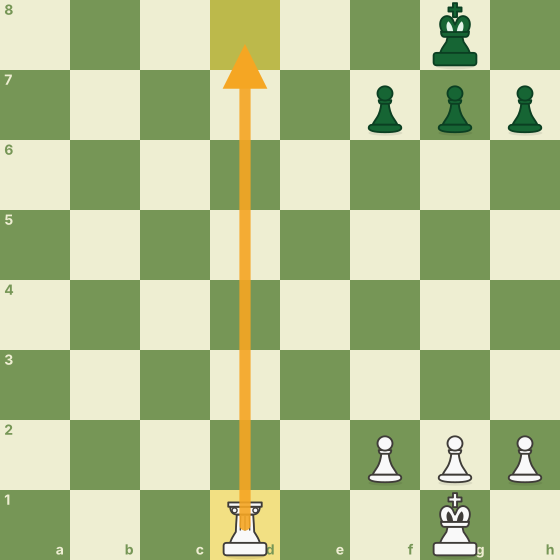
Patterns you must know before a 1400 rating: the fork, the pin, the skewer, the discovered attack, the back-rank mate, and deflection. These six patterns make up most of the tactics you'll encounter.
Step 4: Review every game you lose
If tactics are muscle, game analysis is the mirror. Without a mirror you don't know which muscles are weak.
Reviewing a game properly doesn't take an hour. Ten minutes is enough if the order is right:
- Before turning on the engine, step through the game yourself and mark the one moment you think was the turning point. Guess first.
- Only then turn on the engine. See whether your guess was right. If the engine points to a different moment, that's where your weakness lies: you didn't sense anything was wrong even though your position had already collapsed.
- For every blunder, ask "what was I thinking at the time?" The answer is usually one of: didn't see the opponent's threat, too fast, or thought the piece was defended. Write it down. After ten games, those notes tell you your own mistake patterns — and that's worth far more than anyone's advice.
- Don't study every move. Focus on the one or two biggest moments. Ignore the rest.
On Katuranga, the Analysis feature labels every move as brilliant, best, good, inaccuracy, mistake, or blunder, then calculates your game's accuracy. That accuracy number is what's worth tracking week to week — not rating. Rating can go up and down through luck; accuracy can't. If your average accuracy rises from 70 to 78 percent, your rating will follow, perhaps a month later.
Step 5: Openings — enough, but not too much
There are two opposite mistakes with openings. The first: not caring at all, leaving the opening in a mess, then losing to an opponent's tactic on move 12. The second, more common among players who have become "serious": memorizing 20 moves of Sicilian Najdorf theory while still rated 1100, against opponents who will never play by the book.
The middle path:
- Choose one opening as White (for beginners: 1.e4 with the Italian Game, or 1.d4 with the London System).
- Choose one answer to 1.e4 and one to 1.d4 as Black.
- Learn the first 8–10 moves along with their ideas, not 25 moves. What matters: where the minor pieces go, when to castle, which pawns to push.
- After that, let your rapid games and your analysis teach the rest. If you repeatedly get bad positions in the same opening, then study that line.
The article the best openings for beginners on this site goes through those choices one by one, and Katuranga's Explore shows the full opening tree with result percentages.
Step 6: Basic endgames to master before 1500
This is the most neglected part, and the one that gives points back fastest. A great many games at 1000–1500 end drawn when they should have been won, or lost when they should have been drawn, simply because the player didn't know the most basic endgame technique.
The essentials, in priority order:
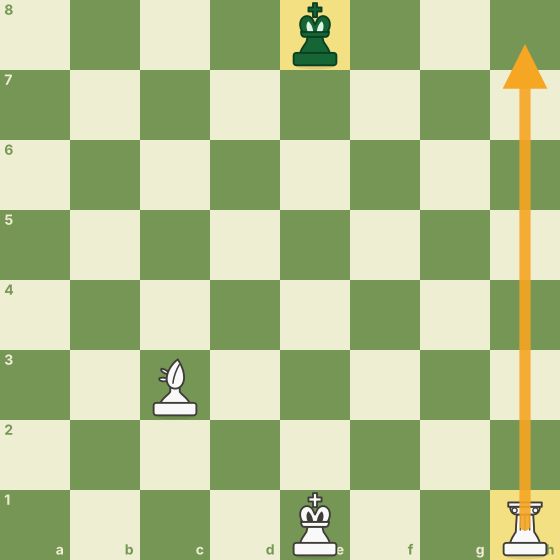
- Mate with king + queen against a lone king — without stalemate.
- Mate with king + rook against a lone king.
- The rule of the square to know whether the king can catch a passed pawn.
- Opposition in king + pawn vs king endgames.
- The active rook principle and rooks behind passed pawns.
These five things can be learned in a week, and used for a lifetime. The complete guide is in how to learn chess endgames.
Step 7: Manage the psychology of rating
This part sounds soft, but its effect is real and measurable.
Stop looking at the rating number before and after games. Every time you see "+8" or "−9", your brain makes its next decision based on emotion, not the position. Many strong players hide their opponent's rating and their own during a playing session. Try it for a week.
Set a number of games per session, not a rating target. "Today I'll play three rapid games and then review one loss" is an achievable target. "Today I have to break 1300" is an invitation to tilt.
Accept that rating climbs like stairs, not like a slope. There are weeks-long flat periods, then suddenly a jump of 100 points in a few days. The flat period isn't wasted time — it's patterns settling in. People who stop training during the flat period never experience the jump.
Case study: from 1050 to 1400 in four months
So it doesn't sound like theory, here's a pattern seen again and again among Katuranga players who review their games regularly. A rapid player rated 1050 started keeping a mistake log. After two weeks, the log said almost the same thing every day: "didn't see the enemy queen could take a pawn while threatening a rook" and "too fast around move 20". Those two sentences revealed two things: a weakness with queen forks, and running out of patience in the middle of the game.
The fix was simple. A month of fork-themed puzzles, and a new rule: after move 20, every move must pass the three questions. The rating stayed flat for three weeks — then jumped from 1100 to 1250 in ten days. In the fourth month it touched 1400, with average accuracy rising from 68 to 79 percent. No new openings, no thick books. The only change was two weaknesses found through the log, then fixed one by one.
That's the core of this entire guide: you don't need to fix everything. You need to know what brings you down most often, and the only way to know is to review your own games.
A realistic weekly routine
If all of the above feels like a lot, here's a version that people with jobs and families can run — about 30–45 minutes a day:
- Every day: 10 tactics puzzles calculated to the end (10 minutes).
- Every day: 1–2 rapid games at 10+0 with the three-question rule (20–30 minutes).
- Every lost game: a 10-minute review, and one sentence written about why you lost.
- Once a week: learn one basic endgame technique, or one opening idea (20 minutes).
- Once a week: reread your mistake log. Look for what repeats. That's next week's homework.
This routine, run for three months, consistently takes players from 800 to 1200, or from 1200 to 1500. Not because the routine is magic, but because it attacks all three causes of stagnation at once: blunders, speed, and not learning from losses.
How long until my rating goes up?
An honest question deserves an honest answer. With the routine above:
- 800 → 1000: usually 3–6 weeks. Almost entirely from no longer giving away free pieces.
- 1000 → 1200: 1–3 months. Basic tactics and basic endgames start to pay off.
- 1200 → 1500: 3–8 months. Here positional understanding becomes necessary: weak pawns, weak squares, active vs passive pieces.
- 1500 → 1800: 6–18 months. You need more structured openings, deeper endgames, and the ability to calculate 3–4 moves accurately.
- Above 1800: years, and most people need a coach or a study group.
These numbers are for adults training with a focused routine. Children are usually faster. People who just play without reviewing their games can stay at the same rating for years — and that isn't the exception, it's the situation of most online players.
Common mistakes that slow progress
Before closing, a few traps you'll often run into:
- Watching too much, playing too little. Chess videos are fun, but watching grandmasters play doesn't raise your rating, just as watching badminton doesn't make your smash harder.
- Changing openings every time you lose. The opening is rarely what's wrong; what's wrong is usually the blunder on move 15.
- Playing bots that are too easy. A bot that always loses makes you feel great and teaches nothing. In Katuranga's Play Bot, pick a level where you win about 40–60 percent of the time.
- Avoiding stronger opponents. Losing to an opponent 200 points above you only costs a few points, but the game is full of lessons.
- Resigning too early. Below 1800, your opponent will make mistakes. A position that's a piece down is still worth playing. Train yourself to defend and look for chances.
Closing: rating is a consequence, not a goal
If there's one sentence worth remembering from this entire article, it's this: rating is a consequence of the quality of your decisions at the board, and decision quality is shaped by how you train, not by how many games you play.
Swap bullet for rapid. Ask three questions before you move. Calculate puzzles to the end. Review every loss and write down why. Master the five basic endgames. Then be patient through the flat periods.
The rating will follow. It always does.
Frequently asked questions
What is the average chess rating on Chess.com?
The average rapid rating on Chess.com is in the 600–900 range, because most accounts are casual players. A 1200 rating already puts you above most online players, 1500 above roughly 90 percent, and 2000 among fewer than 2 percent of players.
Is a Chess.com rating the same as a FIDE rating?
No. Online ratings are usually higher than FIDE ratings for the same player, and the gap varies by time control. As a rough picture, a 1500 Chess.com rapid rating is roughly equivalent to 1200–1300 FIDE, but this is only an estimate and doesn't apply to everyone.
Why did my rating drop even though I feel I'm playing better?
Because rating reacts to results, not to the quality of play, and short-term results are affected by luck and your opponents' form. Track your game accuracy in analysis, not your rating — if accuracy rises consistently, your rating will follow within a few weeks.
Is it better to play rapid or blitz to gain rating?
Rapid, especially below 1500. Rapid gives you time to build the right thinking habits, and those habits carry over to blitz. Playing blitz before those habits are formed just repeats the same mistakes faster.
How many tactics puzzles should I do every day?
Five to ten puzzles calculated to the end are more useful than fifty guessed ones. What improves your skill is patterns you truly understand, and understanding takes time per puzzle, not a large number of puzzles.
Read also
Cara Jadi Grandmaster Catur: Tangga Gelar FIDE, Syarat Norma, dan Berapa Lama Sebenarnya
Penjelasan lengkap tangga gelar catur resmi — CM, FM, IM, GM dan gelar putri — syarat rating dan norma, cara turnamen dihitung, berapa lama jalannya, serta jalur realistis untuk pemain Indonesia yang mulai dari nol.
Kenapa Kamu Selalu Kalah Main Catur? 8 Penyebab Paling Umum (dan Obatnya)
Bukan karena kamu bodoh, bukan karena lawan pakai mesin. Delapan penyebab kekalahan yang benar-benar sering terjadi di catur amatir — bidak gantung, buru-buru, main terlalu banyak, sampai kebiasaan menyalahkan koneksi — lengkap dengan obat yang bisa dicoba hari ini.

Aplikasi Catur Online Gratis Terbaik 2026: Cara Memilih yang Cocok untuk Kamu
Bingung memilih aplikasi catur? Panduan jujur soal apa yang benar-benar perlu kamu lihat — lawan yang setara, analisis, teka-teki, ukuran aplikasi, kuota internet, dan mana yang benar-benar gratis. Termasuk daftar periksa sebelum kamu memasang apa pun.
Try it on the board
Reading alone doesn't raise your rating. Play one game against a bot, then review it — Katuranga marks your brilliant moves, mistakes, and blunders with Stockfish.