Every online chess player in Indonesia eventually faces the same question: Lichess or Chess.com? Both are giants, both have millions of players, and both have fanatical supporters ready to argue for hours. This article tries to answer it without fanaticism — from the point of view of an Indonesian player who wants to learn, play, and maybe doesn't want to spend hundreds of thousands of rupiah every month.
We compare nine things: business model, rating system, analysis quality, puzzles, learning material, community and tournaments, anti-cheating, mobile apps, and price. At the end there are recommendations by player type, and an honest section about where Katuranga stands between the two.
The most fundamental difference: who pays
Before getting into features, understand one difference that explains almost all the others.
Lichess is a non-profit organization. Its code is open source, there are no ads, no paid subscriptions, and every feature is free for everyone. Costs are covered by voluntary donations — "Patrons" only get a small wing badge next to their name, no extra features. Lichess is run by a small team and hundreds of volunteers.
Chess.com is a commercial company, and the biggest in the chess world. Some features are free, but the most valuable ones — unlimited analysis, unlimited puzzles, courses, videos — are locked behind Gold, Platinum, or Diamond subscriptions. Chess.com employs hundreds of people, produces content at large scale, and runs tournaments with millions of dollars in prizes.
There's nothing wrong with either model. But it explains why Lichess feels "clean but simple" and Chess.com feels "complete but always offering an upgrade".
1. Rating system: why the numbers differ
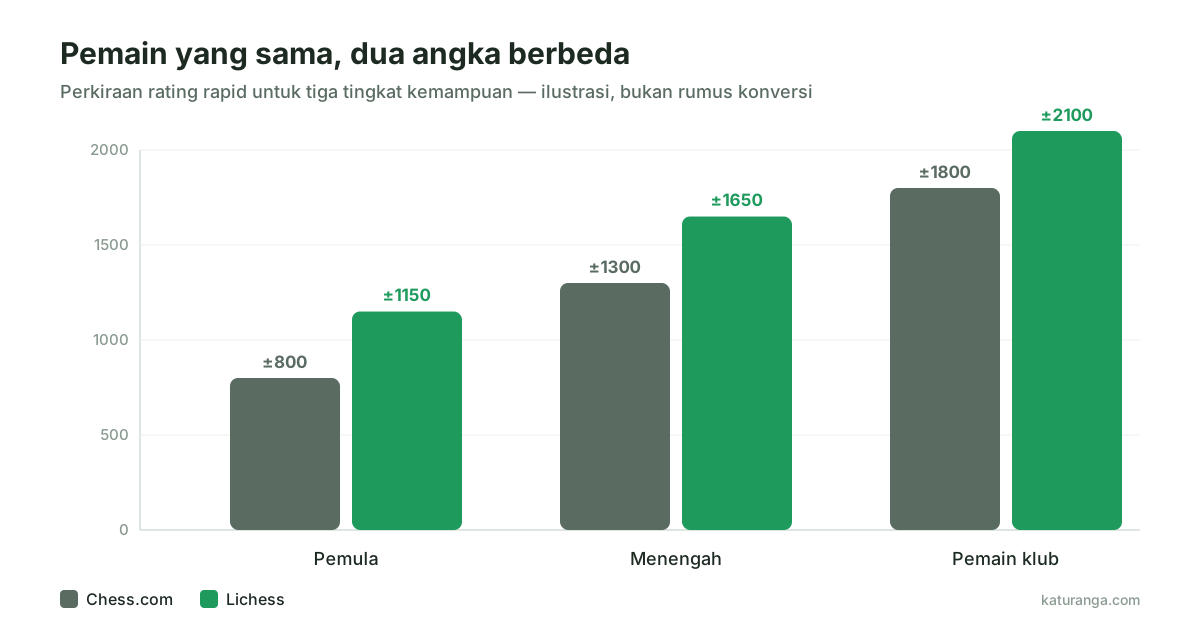
The most common question: "My rating on Lichess is 1600 but on Chess.com it's only 1250. Which one is right?"
Both are right — for their own populations. Lichess uses Glicko-2 with a starting rating of 1500; Chess.com also uses Glicko-2 but with a lower starting rating and a different population. As a result, Lichess ratings are generally 200–400 points higher than Chess.com for the same player, especially at fast time controls.
A few practical notes:
- Don't compare numbers across platforms. Compare percentiles: both sites show what percentage of players are below you.
- Lichess ratings for new players stabilize faster, because they start at 1500 with a large deviation and often face a more varied range of opponents right away.
- If you want to estimate a FIDE rating, Chess.com rapid is usually closer than Lichess — but both are only rough estimates.
A complete guide to how rating works and how to raise it is in how to improve your Elo rating.
2. Game analysis: free on one, limited on the other
This is the biggest differentiator for players who are serious about learning.
Lichess: unlimited, free Stockfish analysis for every game, complete with an evaluation graph, move classification (inaccuracy, mistake, blunder), and a "Learn from your mistakes" feature that asks you to find the better move yourself. You can also run the engine in your browser as deep as you like, anytime.
Chess.com: "Game Review" with human-language coaching ("This is a good move because…"), finer classifications (including Brilliant and Great), and an easy-to-understand accuracy number. But for free accounts, Game Review is limited to one game per day; the rest require a subscription.
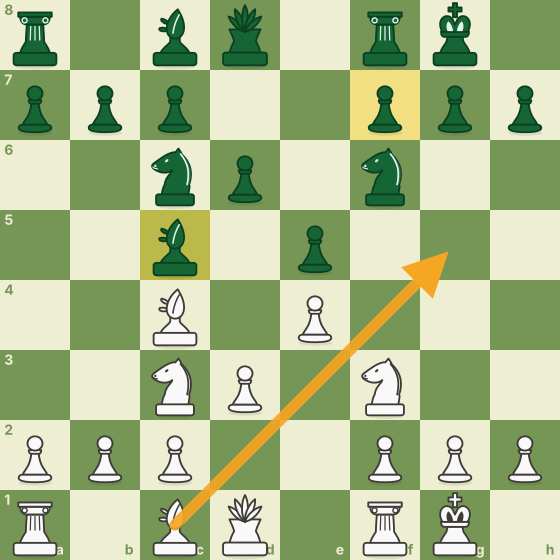
An honest assessment: the engine behind both is the same (Stockfish). The difference is in presentation. Chess.com is friendlier to beginners with its explanations; Lichess is more honest and unlimited but expects you to understand evaluation numbers yourself. For players who review more than one game a day without wanting to pay, Lichess wins decisively.
3. Puzzles: quantity vs curation
Lichess has more than three million puzzles generated automatically from real games, all free and unlimited. There's Puzzle Streak, Puzzle Storm (how many in 3 minutes), Puzzle Racer (racing other people), and themed puzzles (forks, pins, mate in 2, and so on) that can be filtered.
Chess.com has more curated puzzles, Puzzle Rush (similar to Storm), and Puzzle Battle. The average quality per puzzle is slightly better thanks to human curation, but free accounts are limited to a few puzzles per day.
For players who want a routine of 10 puzzles a day as suggested in our rating guide, the free Chess.com daily limit becomes a real problem. Lichess doesn't have that problem.
4. Learning material: here Chess.com is far ahead
If you want structured courses, video lessons, and explanations from grandmasters, Chess.com has no equal. Thousands of lessons from openings to endgames, videos from top players, and learning paths arranged by level. All of it, again, mostly behind a subscription.
Lichess has a "Learn" section with basic exercises (piece movement, coordinates, basic tactics), "Practice" for endgames and tactics, plus thousands of user-made Studies — some very good, many half-finished. There's no complete official curriculum.
For Indonesian players, both have one big drawback: almost all the material is in English. Lichess's interface has been translated into Indonesian by volunteers, but the lesson content hasn't. Chess.com has some translated articles, but its courses and videos are in English.
5. Community, tournaments, and streamers
Chess.com is the center of the online chess world. Big tournaments (Speed Chess Championship, Titled Tuesday), almost all the major streamers, official clubs, and integration with FIDE championships. If you want to watch chess, Chess.com is the place.
Lichess has arena tournaments every hour, free, often joined by titled players. Its community is smaller but very active, especially among players who value open source. Lichess tournaments feel more like "competition between players", Chess.com tournaments more like "a show".
For Indonesian players, Indonesian chess clubs exist on both platforms, and local community tournaments tend to be held on Lichess because it's free and easy to set up.
6. Anti-cheating
Both are serious, with different approaches.
Chess.com uses large-scale statistical detection and closes hundreds of thousands of accounts a year, including some titled players — the cases often make the news. The system is closed (nobody knows exactly how it works).
Lichess also uses automatic detection plus user reports, and marks cheating accounts with a publicly visible label. Its system is more transparent because part of its code is open.
A reality to accept on both platforms: below 1500, you will meet players who occasionally use an engine. It can't be completely avoided on any free platform. What you can do: report, don't tilt, and remember that your long-term rating isn't affected by one or two games against a cheater.
7. Mobile apps
Chess.com has a bigger, more complete app (puzzles, lessons, videos, character bots), but it's also heavier, sends more notifications, and is full of upgrade offers.
Lichess has a light, fast, ad-free app that works almost the same as the web version. On phones with little memory and Indonesian connections that aren't always stable, Lichess feels far more comfortable.
One note: neither app yet offers a complete offline engine for playing bots without a signal — Chess.com has limited offline bots, Lichess needs a connection. That's a gap filled by local apps like Katuranga, which bundles Stockfish inside the app so you can play without internet.
8. Price in Rupiah
Lichess: Rp0. Forever, for every feature. Voluntary donations.
Chess.com: subscription prices vary by region and promotion, but for Indonesia the range is about Rp80,000–Rp200,000 per month depending on tier (Gold, Platinum, Diamond), or cheaper if paid yearly. For students and casual players, that's not a small amount — equal to a month's mobile data plan or more.
The question to ask honestly: which paid features do you actually use? If the answer is "unlimited analysis and puzzles", Lichess gives both for free. If the answer is "structured video courses from GMs", Chess.com is worth paying for.
9. Features found on only one platform
Some distinctive features that might decide your choice:
Only on Lichess:
- A very powerful board editor and Studies for creating your own material — many Indonesian chess coaches use this.
- A full set of chess variants: Chess960, Crazyhouse, Atomic, Antichess, King of the Hill, and more.
- Live tournament broadcasts that anyone can create.
- Unlimited PGN export, and an open API for developers.
Only on Chess.com:
- Character bots (from beginner up to an engine "Magnus") that are fun to practice against.
- Brilliant/Great classifications in Game Review — covered in depth in what is a brilliant move.
- Insights that summarize your strengths and weaknesses from hundreds of games.
- A content ecosystem: news, articles, videos, streamers — all in one place.
10. The everyday playing experience: matchmaking, board, and connection
There are small things that don't make it into comparison tables but are felt every day.
Finding an opponent. On both platforms, 10+0 rapid players usually get an opponent within seconds. The difference shows in less popular time controls (for example 15+10 or 30+0 classical): Chess.com has more players so matchmaking is faster, while on Lichess you sometimes wait half a minute during Indonesia's quiet hours (WIB mornings, when Europe and America are asleep).
Board and pieces. Lichess is known for its clean, fast board that can be customized in detail — including chained premoves and responsive piece-movement settings. Chess.com has more visual themes and sound effects, but its interface is busier. For blitz and bullet players, many feel Lichess is a bit lighter in the hand.
Connection and lag. Both servers are outside Indonesia, so there's a delay (lag) of a few dozen milliseconds that isn't noticeable in rapid but is in bullet. Both compensate for lag automatically. More importantly: the Lichess app handles dropped connections more gracefully — if your signal disappears for three seconds, your game is usually still there when it comes back.
Distractions. Free Chess.com shows ads and upgrade offers in many places; Lichess shows nothing but the board. This seems trivial at first, but after hundreds of games, that calm screen is noticeable.
11. Switching platforms: can ratings and games come with you?
Ratings can't be transferred — you start over on the new platform, and that's reasonable since the populations differ. But your games can come with you. Both support PGN export: Lichess lets you download your entire game archive in one file, Chess.com per game or per month. That PGN file can be uploaded to any platform for analysis — including Katuranga's Analysis.
Practical advice if you decide to switch or use both:
- Pick one platform as your "rating home", where you play seriously and track progress. Playing seriously in two places at once makes both ratings unstable.
- Save your PGN archive once a month. Your games are your learning record; don't leave them stored with just one company.
- Don't panic if your early rating on a new platform looks low. New accounts have a large rating deviation; within 20–30 games the number will find its own level.
Recommendations by player type
To keep it practical, here are direct answers for a few Indonesian player profiles:
- Students on a tight budget who want to learn seriously: Lichess. Unlimited analysis and puzzles are the two things that raise rating most, and both are free there.
- Casual players who want entertainment and something to watch: the free version of Chess.com. Character bots, one Game Review a day, and the whole streaming world are there.
- Intermediate players (1500+) who want structured English courses and can afford it: Chess.com Diamond. Its courses and videos are genuinely good.
- Coaches or club organizers: Lichess, because of Studies, Broadcasts, and unlimited free tournaments.
- Players who want everything in Indonesian, including analysis explanations and courses: this is what neither answers — and the reason we built the next section.
Where Katuranga stands
We won't pretend Katuranga is as big as either of them — it's much smaller, and built in Indonesia for Indonesian players. But there are a few things we designed precisely because they don't exist on Lichess or Chess.com:
- Everything in Indonesian, including analysis explanations, graded courses, and advice from the AI Coach — not just translated buttons.
- Offline bots in the Android app: Stockfish is bundled inside the APK, so you can play with no signal at all.
- Graded courses in Padepokan: five tiers, six classes per tier, with a daily allowance that's free for everyone.
- Analysis with Brilliant classification and accuracy like Chess.com — free accounts get one game per day, the same as there, with paid plans priced in Rupiah and paid via QRIS or GoPay.
- Community tournaments that users can create, with players from your own city and province on the leaderboard.
If you're already comfortable on Lichess or Chess.com, there's no reason to switch. But if you want to learn in your own language, or want bots with no quota, try Katuranga — it's free to sign up, and you lose nothing if it turns out not to suit you.
A quick comparison table
For those who want to see everything at a glance:
- Price: Lichess completely free · Chess.com limited free, subscriptions ±Rp80,000–200,000/month.
- Engine analysis: Lichess unlimited · Chess.com 1 game/day (free), unlimited (paid).
- Puzzles: Lichess unlimited, 3 million+ · Chess.com daily limit (free), more carefully curated.
- Courses & videos: Lichess basic and community-made · Chess.com very complete, paid.
- Move classification: Lichess inaccuracy/mistake/blunder · Chess.com + Brilliant, Great, accuracy.
- Mobile app: Lichess light and ad-free · Chess.com complete but heavy.
- Community & viewing: Lichess free tournaments every hour · Chess.com the hub of streamers and big tournaments.
- Chess variants: Lichess complete (Chess960, Crazyhouse, etc.) · Chess.com a few.
- Coaching tools: Lichess Studies, Broadcasts, API · Chess.com Classroom (paid).
- Indonesian language: both only the interface; lesson content is in English.
Conclusion
Lichess vs Chess.com isn't a question of "which is better", but "which is better for you":
- Lichess wins on price (completely free), unlimited analysis, unlimited puzzles, a light app, tools for coaches, and transparency.
- Chess.com wins on learning material, beginner-friendly analysis explanations, community and viewing, character bots, and integration with the professional chess world.
Many serious players end up using both: Lichess for practicing and reviewing games without limits, Chess.com for watching, following the news, and playing occasionally. No rule forbids it — and there's no rating you have to choose between.
Whatever the platform, it isn't the site that raises your rating. What raises your rating is reviewing your own games, working through tactics thoroughly, and mastering basic endgames — three things you can do on Lichess, on Chess.com, or on Katuranga, with the same results.
Frequently asked questions
Is Lichess really free?
Yes, completely. Lichess is a non-profit organization with open-source code; every feature, including Stockfish analysis and unlimited puzzles, is available at no cost and without ads. "Patron" donations only give a badge, not extra features.
Why is my rating higher on Lichess than on Chess.com?
Because the player populations and starting ratings are different. Lichess starts new players at 1500, so its whole scale shifts upward; for the same player, the Lichess rating is usually 200–400 points higher. Compare percentiles, not the numbers.
Which is better for beginners, Lichess or Chess.com?
For learning at no cost, Lichess, because analysis and puzzles aren't limited. For beginners who want human-language explanations and structured English courses, Chess.com is friendlier, but most of its features are paid.
Does Chess.com have a free version?
Yes. A free Chess.com account can play without limits, but Game Review is limited to one game per day, puzzles to a few per day, and most courses and videos are locked behind Gold, Platinum, or Diamond subscriptions.
Can I use Lichess and Chess.com at the same time?
Yes, and many serious players do: Lichess for practicing and reviewing games without limits, Chess.com for watching tournaments, following the news, and playing occasionally. Ratings on the two are separate and don't affect each other.
Read also
Aplikasi Catur Online Gratis Terbaik 2026: Cara Memilih yang Cocok untuk Kamu
Bingung memilih aplikasi catur? Panduan jujur soal apa yang benar-benar perlu kamu lihat — lawan yang setara, analisis, teka-teki, ukuran aplikasi, kuota internet, dan mana yang benar-benar gratis. Termasuk daftar periksa sebelum kamu memasang apa pun.
Cara Jadi Grandmaster Catur: Tangga Gelar FIDE, Syarat Norma, dan Berapa Lama Sebenarnya
Penjelasan lengkap tangga gelar catur resmi — CM, FM, IM, GM dan gelar putri — syarat rating dan norma, cara turnamen dihitung, berapa lama jalannya, serta jalur realistis untuk pemain Indonesia yang mulai dari nol.
Kenapa Kamu Selalu Kalah Main Catur? 8 Penyebab Paling Umum (dan Obatnya)
Bukan karena kamu bodoh, bukan karena lawan pakai mesin. Delapan penyebab kekalahan yang benar-benar sering terjadi di catur amatir — bidak gantung, buru-buru, main terlalu banyak, sampai kebiasaan menyalahkan koneksi — lengkap dengan obat yang bisa dicoba hari ini.
Try it on the board
Reading alone doesn't raise your rating. Play one game against a bot, then review it — Katuranga marks your brilliant moves, mistakes, and blunders with Stockfish.