
The question "what's the best opening for beginners" comes up on every chess forum, every week, since the internet began. The answer is almost always a long list of foreign names — Ruy Lopez, Sicilian, Grünfeld — that makes beginners feel they must memorize them all before they're allowed to play. That's wrong. Beginners don't need many openings. Beginners need a few openings whose ideas they truly understand.
This article picks just five: one main opening as White, one backup, and three answers as Black. All five were chosen by one measure — whether a beginner can understand why each move is played, not just what the move is. Before the list, let's clarify what an opening is really after.
What is the goal of the opening?
The opening isn't about trapping your opponent or memorizing a book. It's about three simple things that, once achieved, make the middlegame much easier to play:
- Control the center of the board. The e4, d4, e5, and d5 squares are the most valuable ground. Pieces that stand on or control the center reach more squares.
- Develop the minor pieces. Knights and bishops must leave the first rank as quickly as possible. Pieces still at home don't join the fight.
- Secure the king. Castle before move 10 in almost every case. A king in the center is a target; a king in the corner is a safe spectator.
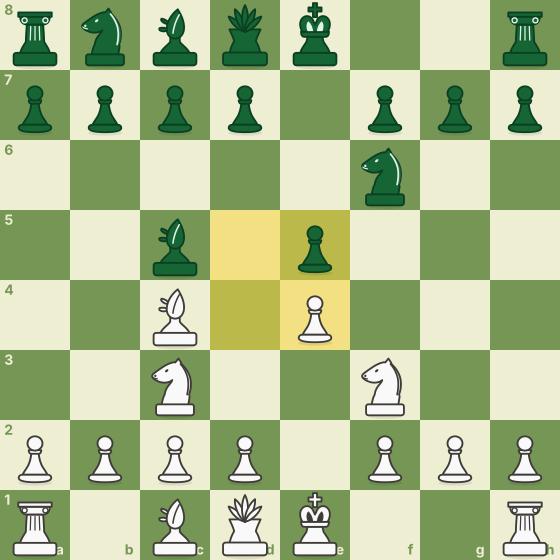
These three principles are worth more than a hundred moves of theory. A player who follows them without memorizing anything will leave the opening with a healthy position against anyone below a 1500 rating. A player who memorizes 15 moves but doesn't understand the principles will get lost as soon as the opponent deviates from the book on move 4 — and opponents always deviate.
There are also a few prohibitions that matter just as much:
- Don't bring the queen out too early. A queen that comes out on moves 2–4 gets chased by enemy minor pieces, and every chase is a free developing move for your opponent.
- Don't move the same piece twice before all your minor pieces are out, unless you have to.
- Don't push the edge pawns (a, h) in the opening. a3 or h3 is only useful when there's a concrete reason.
- Don't attack before developing. An attack with two pieces against your opponent's whole army never works against someone who knows how to defend.
1. Italian Game — the main opening as White
Moves: 1.e4 e5 2.Nf3 Nc6 3.Bc4
If you could choose only one opening for beginners, this is the answer, and it's the one almost every coach in the world uses with new students. The reason isn't that the Italian Game is the strongest — it's that every move is a lesson in opening principles.
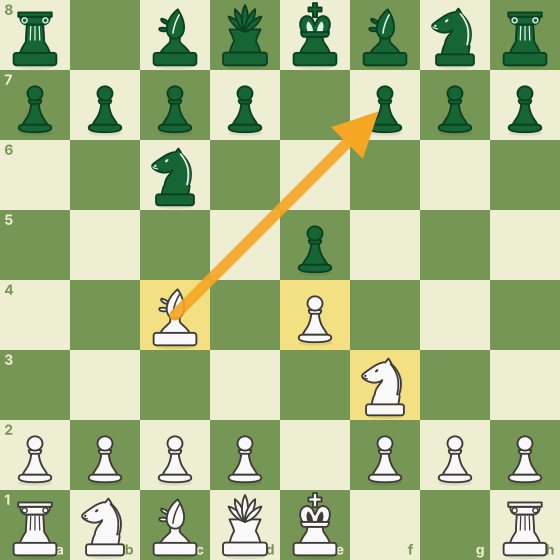
Look at the order. 1.e4 grabs the center and opens lines for the bishop and queen. 2.Nf3 develops the knight while attacking the e5 pawn. 3.Bc4 develops the bishop to its most active diagonal, aiming at f7. After that the plan is clear: castle, push d3 (or d4 when ready), develop the b1 knight to c3, and start playing in the center.
Key ideas for beginners:
- The c4 bishop and the f3 knight are already "halfway" to an attack on the black king. If Black is careless with f7, there are tactics there.
- The simple d3 pawn is safer than the sharp d4. Choose the Giuoco Pianissimo (3...Bc5 4.d3) — "the very quiet game" — so the position stays stable and you can focus on principles.
- If Black plays 3...Nf6 (the Two Knights Defense), just answer 4.d3. Don't be tempted by 4.Ng5 before your rating is 1400 — there are tactics there, but they cut both ways.
A trap to avoid: don't try Scholar's Mate (queen to h5 on move 2). It wins against beginners who don't know it, and loses against everyone else, because your queen gets chased with tempo. Your opponent develops for free while your queen runs around.
A short sample game: the Italian Game move by move
To make it feel real, here are the first ten moves that very often appear at the 800–1200 level, along with what White is thinking on each move:
- e4 e5 — both sides grab the center. Fair so far.
- Nf3 Nc6 — White attacks e5, Black defends it. Knights come out, not queens.
- Bc4 Bc5 — two bishops go to their most active diagonals. Both eye the f7 and f2 squares.
- c3 Nf6 — White prepares d4 to drive away the c5 bishop and take the full center. Black develops the knight and attacks e4.
- d3 d6 — White chooses the quiet version: guard e4 first, d4 can come later. Black replies by guarding e5.
- O-O O-O — both kings are safe before move 10. The third principle is met.
- Bg5 h6 — White pins the f6 knight to the d8 queen; Black asks "trade or retreat?".
- Bh4 g5?! — Black drives the bishop away with the g-pawn, but opens up their own king. This is a typical mistake: solving a small problem by creating a big one.
- Bg3 — the bishop retreats and now eyes the e5 pawn along the h2–b8 diagonal. Black already has to be careful.
- Nbd2 — the last knight comes out. All of White's minor pieces are developed; Black has a leaky king.
Not one of White's moves needs memorizing — they all follow the three principles at the start of this article. And see where Black runs into trouble: not because the opening was bad, but because of one pawn move (g5) that broke the principle "don't move the pawns in front of your king without a reason". That's the pattern that repeats thousands of times at beginner level.
2. London System — the backup opening as White
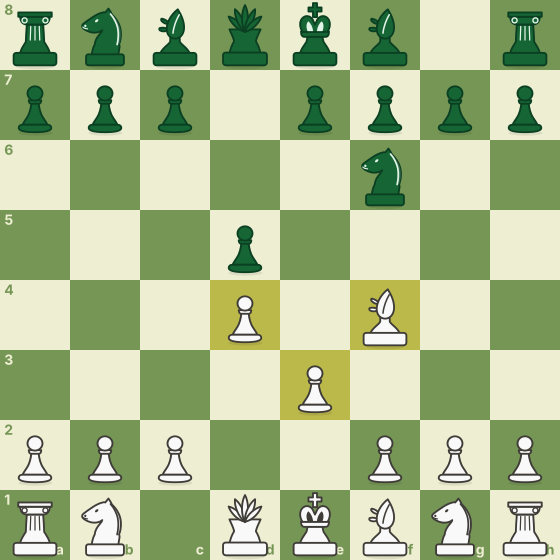
Moves: 1.d4 d5 2.Bf4 (or 2.Nf3 then 3.Bf4)
The London System has become hugely popular in the last ten years, for a sensible reason: its setup is almost the same whatever Black plays. Bishop to f4, pawns to e3 and c3, knights to f3 and d2, the other bishop to d3, castle. Done. You don't have to memorize different answers for every Black reply.
Its advantages for beginners:
- A fixed piece setup means you learn one structure until you really understand it, instead of ten structures you half understand.
- The position is solid. It's very hard for Black to punish the London in the opening; mistakes usually only happen in the middlegame.
- There's a clear attacking plan: knight to e5, queen to f3 or toward the kingside, sometimes the h-pawn advances too.
Its drawback, and it needs saying honestly: the London teaches less about the dynamic fight for the center than 1.e4 does. Players who only ever play the London sometimes struggle in open positions. So our advice: the Italian as your main opening, the London as a backup for days when you want a quiet, predictable position. The two complement each other.
3. As Black against 1.e4: reply 1...e5
As Black you don't choose an opening — you answer. And the most honest answer to 1.e4 for beginners is 1...e5: take your share of the center, open the bishop and queen, and enter positions with the same principles you learned as White.
After 1.e4 e5 2.Nf3, play 2...Nc6 — defending the e5 pawn while developing the knight. Then:
- Against 3.Bc4 (Italian): answer 3...Bc5, develop the g8 knight to f6, castle. The position is symmetrical and you know exactly what White is doing because you play it too.
- Against 3.Bb5 (Ruy Lopez / Spanish): answer 3...a6 then 4...Nf6. Don't fear the Ruy Lopez — at beginner level, the White player usually doesn't know how it continues either.
- Against 3.d4 (Scotch): answer 3...exd4 4.Nxd4 Bc5 or 4...Nf6. Develop, castle, and the center will open up for both sides.
The most common trap to watch for here is the Fried Liver Attack (after 3.Bc4 Nf6 4.Ng5). The easiest way to avoid it: play 3...Bc5, not 3...Nf6. One move choice, and that whole trap never exists.
4. As Black against 1.e4: the Caro-Kann (the more solid choice)
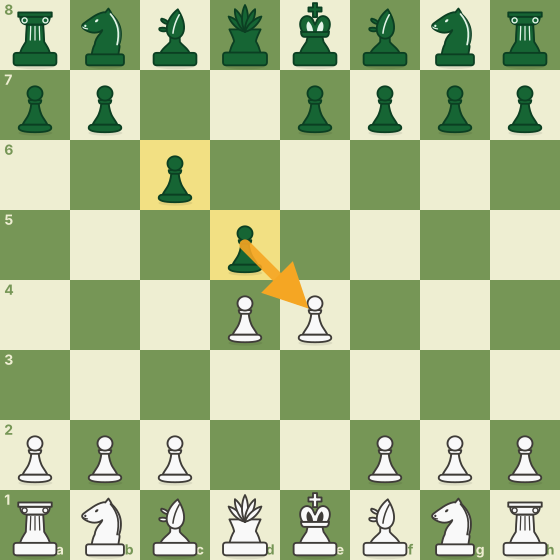
Moves: 1.e4 c6 2.d4 d5
If 1...e5 feels too open and you often get hit by tactics there, the Caro-Kann is a much calmer choice. The idea: the c6 pawn prepares d5 so the d5 pawn is defended by the c6 pawn, not the queen. Unlike the French Defense (1...e6), the c8 bishop isn't locked in — it can come out freely to f5 or g4.
Why it suits beginners:
- Its pawn structure is healthy and hard to break. Black rarely loses quickly in the Caro-Kann.
- The plan is simple: develop the c8 bishop first (to f5), then e6, Nf6, Bd6 or Be7, castle.
- The resulting positions teach patience — the skill most lacking in players below 1200.
What to watch out for: the Advance Variation (3.e5). The answer is 3...Bf5, getting the bishop out first, then e6. Don't play 3...e6 before the bishop is out — otherwise you're playing a French Defense with a locked-in bishop, and that isn't the point.
5. As Black against 1.d4: the Queen's Gambit Declined
Moves: 1.d4 d5 2.c4 e6
Against 1.d4, beginners are often confused because there's no "f7 square" to target, and the play is slower. The most principled and easiest-to-understand answer is the Queen's Gambit Declined (QGD): defend the d5 pawn with e6, develop the knight to f6, the bishop to e7, and castle.
Why "declined"? Because Black doesn't take the c4 pawn. Taking it (the Queen's Gambit Accepted) is legitimate, but beginners often try to hold on to that pawn with b5 and a6 — and that's what makes their position collapse. The QGD avoids that whole problem.
An easy-to-remember plan for Black:
- Nf6, Be7, O-O — three developing moves that are always the same.
- Then c6 or c5 to challenge the center, and the c8 bishop comes out via b7 (after b6) or via d7.
- If White trades on d5 (the Exchange Variation), the pawn structure is symmetrical and nobody can lose quickly. Great for learning.
If 1.d4 is followed by 2.Nf3 or 2.Bf4 (London) instead of 2.c4, play Nf6, e6, and c5 — the same thing, the principles don't change.
How should you study them?
Choosing openings is easy; studying them properly isn't. Here's what works for beginners, and what doesn't:
Don't memorize 15 moves from a video. Opponents at beginner level won't play them, and as soon as they deviate, your memorization is useless.
Do this:
- Memorize the first 6–8 moves along with their reasons. For the Italian: e4 (center), Nf3 (develop + attack e5), Bc4 (develop + eye f7), d3 (guard e4, open the c1 bishop), O-O (safety), Nc3 or c3 (plan). If you can name the reasons, you understand the opening.
- Play the same opening for 30 games in a row. Don't switch even if you lose. What went wrong is almost certainly not the opening.
- After every game, check the first 10 moves in Analysis. If the engine marks move 6 as an inaccuracy, find out why — usually because you broke one of the principles above.
- Use Explore to see the opening tree. There you can see the most common replies in each position and their result percentages. Study the branches that come up most often, ignore the rare ones.
- After 100 games with the same opening, you'll recognize its positions like the way home. That's when you can add a new opening — if you want.
For those who want to see openings played by the best, Katuranga's Master Games section contains classic games you can step through move by move — many of them Italians and Ruy Lopez.
The most common opening mistakes
From the games reviewed on Katuranga, these are the principle violations that most often bring beginners down, from most to least common:
- The queen coming out on moves 2–4. Chased by a knight, chased by a bishop, chased by a pawn — your opponent develops fully while you're still rescuing your queen.
- Castling late or not castling at all. A king on e1/e8 with an open center is the easiest target for tactics.
- Too many pawn moves. a3, h3, a6, h6 "just in case". Every unnecessary pawn move is one minor piece coming out late.
- Trading a bishop for a knight without a reason. Bxc6 or Bxf6 is only good with a concrete reason (damaging the pawn structure, gaining a tempo). If there isn't one, don't trade.
- Chasing edge pawns. A queen that grabs the b2 or b7 pawn in the opening (the so-called poisoned pawn) often ends up trapped.
All these mistakes share one root: forgetting that the opening is preparation, not battle. The winner in the opening isn't the one who attacks first, but the one who's more ready when the battle really begins.
When can you switch openings?
A beginner's biggest temptation is switching openings every time they lose. Resist it. Switch openings only if:
- You've played it at least 100 games and understand its plans.
- Analysis shows you repeatedly leave the opening with a bad position — not losing because of a blunder on move 25.
- You feel the style of positions truly doesn't suit the way you think (for example, you always want to attack but play the slow London).
If those three conditions are met, have a look at the 10 best openings for every rating level — the choices there are wider and arranged by your strength.
Quick summary: a beginner repertoire on one card
If you only want to keep one note on your phone, here's what goes on it:
- As White, main: Italian Game — 1.e4 e5 2.Nf3 Nc6 3.Bc4, then d3, O-O, c3 or Nc3.
- As White, backup: London System — 1.d4 d5 2.Bf4, then e3, Nf3, c3, Bd3, Nbd2, O-O.
- As Black vs 1.e4, main: 1...e5 2.Nf3 Nc6, then Bc5 and Nf6, castle early.
- As Black vs 1.e4, backup: Caro-Kann — 1...c6 2.d4 d5, the c8 bishop out before e6.
- As Black vs 1.d4: Queen's Gambit Declined — 1...d5 2.c4 e6, then Nf6, Be7, O-O.
- Rules for all of them: center, minor pieces, castle; the queen stays home until the minor pieces are out; no edge-pawn moves without a reason.
Closing: one understood opening beats ten memorized ones
If this article were condensed into one paragraph: as White play the Italian Game (backup: the London System), as Black answer 1.e4 with 1...e5 (backup: the Caro-Kann) and answer 1.d4 with the Queen's Gambit Declined. Learn the first 6–8 moves with their reasons, play 100 games, review every game, and don't switch.
Openings don't win games at beginner level. What wins games is not giving away free pieces and recognizing simple tactics — both covered in full in how to improve your Elo rating. A good opening only makes sure you reach the middlegame with pieces ready to fight. That's its only goal, and that's more than enough.
Frequently asked questions
What's the easiest opening for beginners?
The Italian Game (1.e4 e5 2.Nf3 Nc6 3.Bc4) as White, because every move teaches opening principles: take the center, develop the minor pieces, secure the king. As Black, 1...e5 against 1.e4 and the Queen's Gambit Declined against 1.d4 are the easiest answers to understand.
Do beginners need to memorize openings?
No. Beginners only need to memorize the first 6–8 moves with their reasons. Opponents at beginner level almost never play by the book, so long memorization is useless — what's useful is understanding principles so you can answer any move.
Is the London System good for beginners?
It's good as a backup opening because its setup is almost the same against anything and the position is solid. Its drawback is that the London teaches less about the dynamic fight for the center, so it's better paired with a 1.e4 opening like the Italian Game.
How many openings do beginners need to learn?
Three: one as White, one answer to 1.e4, and one answer to 1.d4. Play all three for at least 100 games before adding new ones. Too many openings early on actually holds you back, because none of them gets truly understood.
Why isn't Scholar's Mate recommended?
Because it only works against players who don't know it, and against everyone else White's queen gets chased with tempo so Black develops for free. An opening that relies on the opponent making a mistake isn't an opening, it's a gamble.
Read also
The 10 Best Openings for Every Elo Rating: 1000, 1500, 1800, 2000, 2200, 2400, 2600 and Above
The right opening differs at every rating level. Here are the 10 best openings arranged by Elo — from the Italian Game at 1000 to the Catalan and Najdorf at 2400 and above — with the reasons each fits its level, and when to move up.
Cara Jadi Grandmaster Catur: Tangga Gelar FIDE, Syarat Norma, dan Berapa Lama Sebenarnya
Penjelasan lengkap tangga gelar catur resmi — CM, FM, IM, GM dan gelar putri — syarat rating dan norma, cara turnamen dihitung, berapa lama jalannya, serta jalur realistis untuk pemain Indonesia yang mulai dari nol.

Kenapa Kamu Selalu Kalah Main Catur? 8 Penyebab Paling Umum (dan Obatnya)
Bukan karena kamu bodoh, bukan karena lawan pakai mesin. Delapan penyebab kekalahan yang benar-benar sering terjadi di catur amatir — bidak gantung, buru-buru, main terlalu banyak, sampai kebiasaan menyalahkan koneksi — lengkap dengan obat yang bisa dicoba hari ini.
Try it on the board
Reading alone doesn't raise your rating. Play one game against a bot, then review it — Katuranga marks your brilliant moves, mistakes, and blunders with Stockfish.