


The game you've opened on this screen is about fifteen hundred years old. It existed long before chess clocks, before rating numbers, even before the queen could travel as far as we know today. What survived all that time turned out not to be the rules — the rules changed many times — but the idea: two people, one board, no dice, and nobody to blame but yourself.
A name not chosen at random
The Indonesian word for chess, catur, isn't Dutch or English. It comes from Sanskrit, catur, meaning four. The original game was called chaturanga: catur (four) plus angga (part) — the four divisions of an ancient Indian army.
We took the name Katuranga from there. Not because it sounds antique, but because our own language has held the root of this game's name longer than almost every European language that calls it chess, schaak, or échecs.
6th century: four armies on a board
In India, around the 6th century, chaturanga was played on an eight-by-eight board already used by another game (ashtapada). Its pieces were real troops: elephants, horses, chariots, and foot soldiers, plus a king and his advisor.
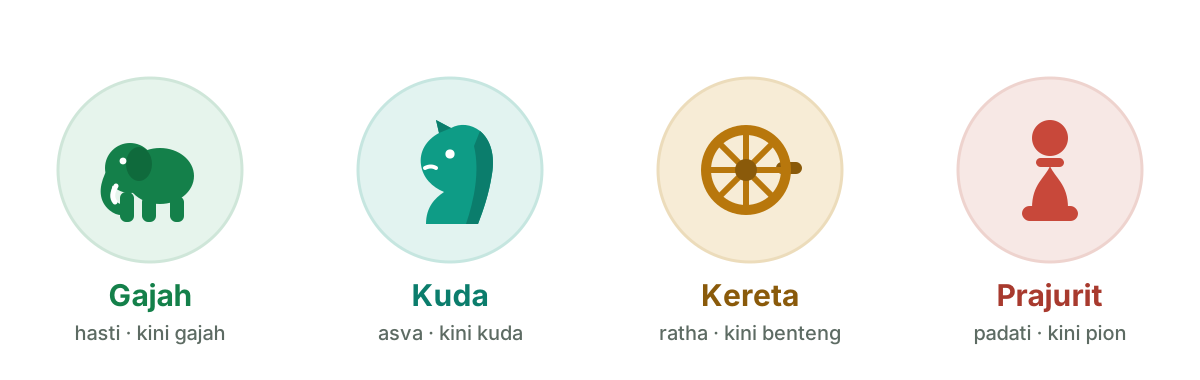
The chariot became the rook. The elephant became the piece English calls the bishop, but in Indonesian its name never changed: gajah, elephant, still an elephant. The soldier became the pawn. And the knight — the only piece to survive a thousand years of reforms untouched — still jumps in exactly the same L-shape as when someone first drew it.
To Persia: a word we still say
From India the game crossed into Persia and was renamed shatranj. The king's advisor there was called the farzin and could only step one square diagonally — far weaker than the queen we know. Games moved slowly, sometimes dozens of moves before anything really happened.
Persia passed down not just the game, but its closing words. When the king had no way out, people said "shāh māt" — the king is helpless. That phrase traveled to Arabia, to Europe, and into our own mouths as "sekakmat" (checkmate). Every time someone says it at the neighborhood watch post, they're speaking 7th-century Persian without ever knowing it.
15th-century Europe: the queen suddenly becomes the strongest
The biggest change happened in Spain and Italy toward the end of the 15th century. The weak farzin was given the power to sweep the whole board and became the queen; the bishop got its long diagonals; pawns could move two squares on their first move. A game that had been sluggish became sharp, fast, and dangerous from move ten.
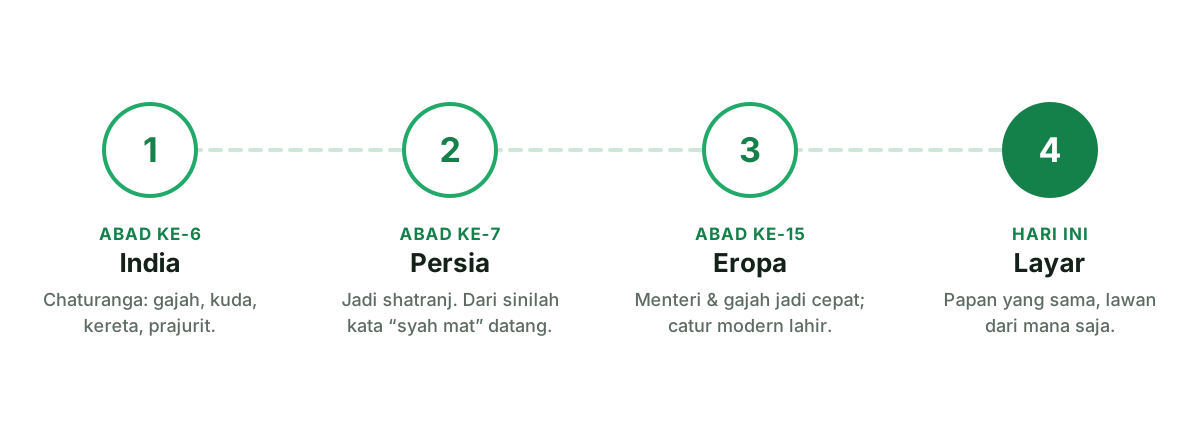
From there came everything we now take for granted: opening theory, analysis books, official tournaments, chess clocks, and then rating numbers that go up and down. Modern chess, in other words, is much younger than chess itself.
How chess came here
In Indonesia, chess has never been an upper-class game. It's at coffee stalls on boards with peeling paint, at neighborhood watch posts toward midnight, at Independence Day contests with prizes smaller than the prestige, and on front porches with spectators far noisier than the two players.
Its organization was founded as the All-Indonesia Chess Association (Percasi), our players compete at the Chess Olympiad, and names like Utut Adianto are known even to people who can't play. But between the board at the watch post and the tournament stage there's a very wide gap — and that gap is why we built this site.
Why we built Katuranga
Playing chess is cheap. A plastic set costs next to nothing, and there's always an opponent to find. What's expensive is explanation. Losing ten times in a row without knowing on which move things started going wrong isn't practice — it's just repetition.
Chess engines have long been able to answer that, but their answer is a number: −2.4. That number is correct and helps no one. What people need is a sentence: here you left your knight undefended, and three moves later that's what lost you the game. In the language they think in every day.
We're not just adding one more chessboard to the internet. We want Indonesians to stop guessing why they lost.
That's why everything here is built from the same angle: graded bots so there's a fitting opponent at every stage, game analysis that shows where the mistake is rather than just its score, graded courses that train how to decide, and tournaments a small club can run without a ten-person committee.
What you can use right now
- Play Bot — ten strength levels, from just learning to one you'll never beat.
- Online duels — a real chess clock, a rating that goes up and down honestly.
- Analysis — accuracy, blunders, best moves, and the reasons behind them.
- Courses — five graded tiers, from Cantrik to Empu.
- Tournaments — knockout or Swiss, online or at real tables.
- Android app — the same board on your phone, including bots without a connection.
Frequently asked questions
Where does chess come from?
From India, around the 6th century, under the name chaturanga — a game whose pieces were the four divisions of an army: elephants, horses, chariots, and soldiers.
Why is the game called catur in Indonesian?
Because the word catur comes from Sanskrit, meaning four, from the original name chaturanga: catur (four) plus angga (part).
Where does the word checkmate come from?
From Persian, shāh māt, meaning the king is helpless — said when the opponent's king has no way out.
Since when has the queen been the strongest piece?
Since the late 15th century in Spain and Italy. Before that, the king's advisor (farzin) could only step one square diagonally.
Where to start?
If it's your first time: play a bot at the lowest level, then review the game. Those two things alone teach more than ten losses without a review.
Note: the history in this piece summarizes what chess historians generally accept. The early dates can never be stated exactly — all that remains from the 6th century are manuscripts and boards, not game records.