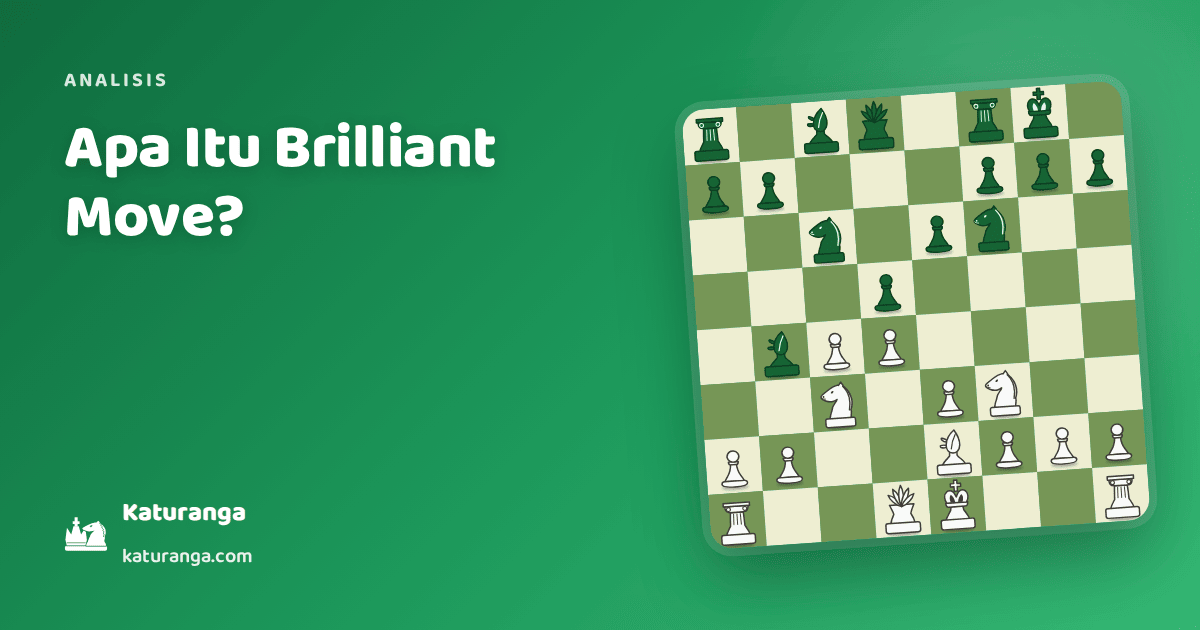
You finish a game, open the analysis, and on one of your moves a light-blue !! appears with the word Brilliant. It feels like winning a trophy. Then the question comes: what actually makes a move brilliant? Why does a move you thought was ordinary earn the badge, while the combination you were proud of only gets "Best"?
This article answers that fully: from the traditional meaning of !! in chess notation, to the technical definition used by modern analysis engines (including the one used by Katuranga), classic examples, why brilliant moves are deliberately rare — and how to find them more often.
The traditional meaning: !! in chess notation
Long before computers, chess book authors were already annotating moves. That annotation system is still used today:
- ! — a good move
- !! — a brilliant move
- ? — a mistake
- ?? — a blunder
- !? — an interesting move, possibly good
- ?! — a dubious move, possibly bad
In this tradition, !! is given by humans, subjectively, for a move that is surprising, hard to find, and turns out to be very strong. Usually it's a sacrifice — a queen given away, a rook abandoned — that at first sight looks like a mistake but actually wins the game. Commentators had no formula; they gave !! when they were impressed.
This old definition matters, because the modern definition used by analysis engines tries to imitate that intuition with numbers.
The modern definition: a brilliant move according to analysis engines
When Chess.com introduced the Brilliant classification in its Game Review, it had to translate "an impressive move" into conditions that can be calculated. The result, with small variations between platforms, is the following definition:
A brilliant move is a move that sacrifices material, is the best (or nearly best) move in the position, and isn't played from a position that is already completely winning or already lost.
Three elements, each needing explanation.
1. There must be a material sacrifice
This is the core condition. If your move doesn't give your opponent any material, it can't be brilliant — no matter how good it is. A quiet move that wins the game positionally gets "Best" or "Great", not "Brilliant".
What counts as a sacrifice: you allow a piece (not a single pawn, but usually worth at least two pawns) to be taken by your opponent without being able to immediately take back equal value. A normal exchange — knight for knight — isn't a sacrifice.
On Katuranga, the condition is exact: the sacrificed material must be worth at least 2 pawns, and the sacrifice must still stand two of your turns later — meaning the material is really gone, not just a capture-recapture that comes straight back the next move. This two-turn rule was added because without it, ordinary exchanges that happen in sequence were counted as "sacrifices" too.
2. It must be the best move, or nearly the best
A sacrifice alone isn't enough. Giving away your queen and then losing isn't brilliant, it's a blunder. The engine compares the evaluation of the position before and after your move: if the evaluation drops by more than a little (on Katuranga: a drop of no more than 0.2 pawns), the move isn't the best one, and the badge is gone.
This is where the engine's strength comes in: Stockfish looks 18–20 moves ahead. If it says the evaluation doesn't drop after you sacrifice a rook, the sacrifice pays off at some point within those 20 moves — mate, material coming back, or an attack that can't be stopped.
3. Not from a position that is already completely winning or lost
If you're already a queen up and sacrifice a rook to mate faster, that's not brilliant — that's technique. Katuranga refuses the badge if the evaluation before the move is already above +5 (already winning big). Conversely, if your position is already lost and you sacrifice something that's "best" only because every other move is worse, that isn't brilliant either: the evaluation after the move must be at least −2.
These two limits are what make a brilliant move feel "fair": it's only awarded for sacrifices in positions that are still contested, where the sacrifice really changes the situation.
Classic examples that are always brilliant
The Greek Gift: Bxh7+
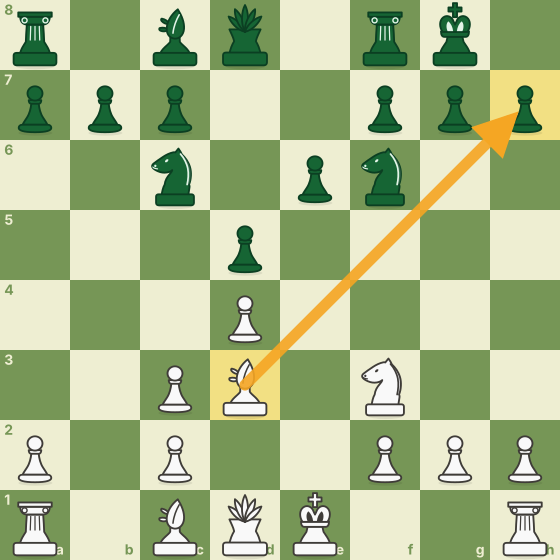
The bishop sacrifice on h7 (or h2 for Black) is a pattern every club player knows: the bishop is given to pull the king out, the knight jumps to g5 with check, the queen comes to h5. If the conditions are met (the knight can reach g5, the queen can reach h5, Black doesn't have enough defenders), the evaluation doesn't drop, and Bxh7+ earns !!.
A bishop is worth three pawns, so the "at least two pawns" sacrifice condition is clearly met. This is why Katuranga uses a threshold of 2, not 3: the Greek Gift gives a bishop for a pawn (3 − 1 = 2), and it must still count.
Légal's Mate: a queen sacrifice for mate with minor pieces
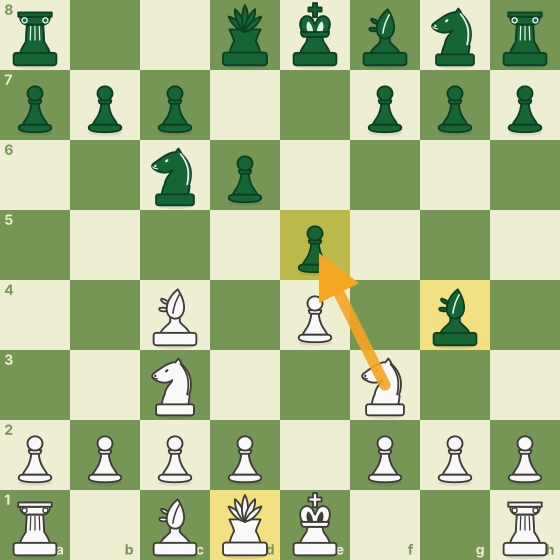
A classic 18th-century pattern: White moves the knight from f3 as if "forgetting" that the queen on d1 is pinned by the g4 bishop. Black takes the queen, and White mates with Bxf7+, Ke7, Nd5#. The biggest material sacrifice possible, and the evaluation doesn't drop because it ends in mate — brilliant by any definition.
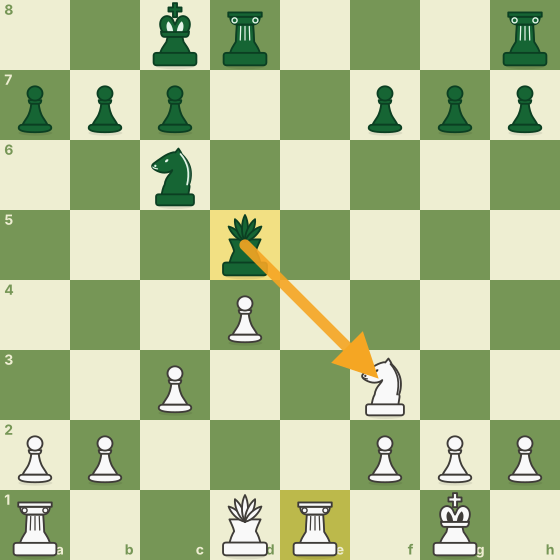
A queen sacrifice to open up the king
Examples that are NOT brilliant, even though they look great
This is the part that confuses people most.
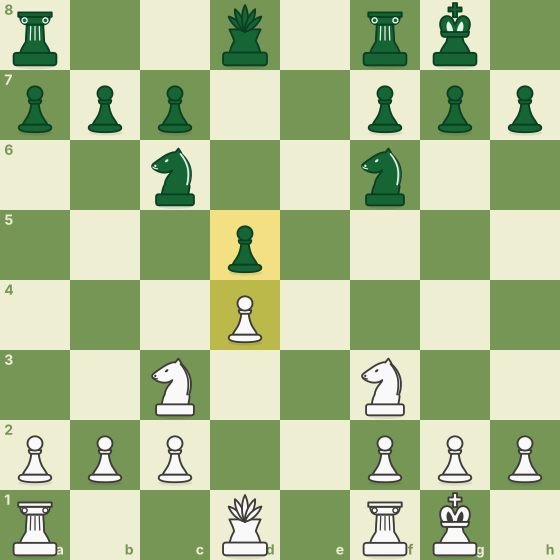
Some kinds of moves that don't earn the brilliant badge, and why:
- The best move without a sacrifice. However good, this is "Best". Brilliant demands material risk.
- A sacrifice in a position that's already winning big. You're two rooks up and give one away for a faster mate. That's technique, not a surprise.
- A sacrifice that isn't the best. You sacrifice a knight and the evaluation drops from +1 to 0. You're still not losing, but there was a better move — so it's "Good" or "Inaccuracy", depending on how far it dropped.
- An exchange that looks like a sacrifice. Nxe5 Nxe5 dxe5: for a moment you "lose a knight", but the material comes back the next move. Katuranga's two-turn rule filters this out.
- A single-pawn "sacrifice". Pawn gambits in the opening are usually below the two-pawn threshold; even if best, they get "Best".
If you're curious whether a move was "almost" brilliant, look at the explanation in Katuranga's Analysis: every move shows the before-and-after evaluation and the engine's best move, so you can see for yourself which condition wasn't met.
Ten sacrifice patterns that most often turn brilliant
To make it concrete, here's a list of the patterns that most often earn the !! badge in amateur games, from most to least common:
- The Greek Gift (Bxh7+ / Bxh2+) — a bishop sacrifice to pull the king out of its castled position.
- A rook sacrifice on the back rank — Rxe8+ or Rd8+ forcing a back-rank mate.
- Deflection — sacrificing a piece to pull a defender away from its duty.
- Shield destruction (Bxg7 / Rxg7) — opening up a king hiding behind its g-pawn.
- A queen sacrifice for a knight mate — the smothered mate pattern: Qg8+ Rxg8 Nf7#.
- A knight sacrifice on f7 / f2 — Nxf7 forcing Kxf7, then Qh5+ or Bc4+.
- A central pawn sacrifice (e5 / d5) that opens lines — the one most often missed because it looks trivial.
- The exchange sacrifice — a rook for a minor piece for a strong square or an attack.
- A bishop sacrifice on e6 / e3 — opening diagonals and wrecking the defense of an uncastled king.
- A sacrifice for a passed pawn — giving up a piece so a runaway pawn can't be stopped in the endgame.
If you know these ten patterns by heart and can calculate them to the end, you've seen most of the brilliant moves that could appear in your games.
Why are brilliant moves deliberately rare?
In early versions of this classification, on many platforms, the brilliant badge was too easy to get — it showed up for ordinary pawn gambits, exchanges that happened in sequence, even quiet moves the engine misread as sacrifices. As a result, the badge lost its meaning.
Katuranga went through the same thing in the first week of its analysis feature (September 2026): out of 49 reviewed games, only four brilliant badges appeared, and not one was really a sacrifice — all were miscalculations because the engine's analysis line contained moves by both sides, so a sacrifice happening three moves later "landed" on the quiet move before it. The two-turn rule and a stricter material check were added after that, and all four were rejected.
The principle: a badge that's easy to get tells you nothing. A brilliant move that appears once in fifty games means something; one that appears every game is just decoration. If you rarely get it, that's not a sign the analysis is stingy — it's a sign the badge is honest.
How to read the brilliant badge in your analysis
When the !! badge appears in Analysis, a few things are worth checking so you actually learn from it, not just feel good:
- Look at your opponent's next move. If your opponent didn't take the piece you sacrificed, maybe they saw something you didn't — or they were the one who went wrong. The engine will show which is right.
- Ask whether you really calculated it. Be honest with yourself: was the sacrifice the result of calculation, or a lucky gamble that happened to be right? Both get the same badge, but only the first can be repeated.
- Save the position. A brilliant move you found yourself is a pattern that's already part of your intuition. Saving it and looking at it again a week later strengthens that pattern.
- Compare it with other games. If you get brilliant three times in the same pattern (for example always a sacrifice on h7), that's your strength — and possibly also a sign you're playing too one-dimensionally.
Conversely, if you feel your move should have been brilliant but it didn't get the badge, check the three conditions one by one: was the material really gone two turns later, did the evaluation drop by more than 0.2, and was the position already winning big before the move? Almost always one of them wasn't met — and knowing which one is the lesson.
Great move: the close relative that often gets mixed up
Chess.com also has a Great classification (the ! mark), which is often mistaken for a "second-class brilliant". It's actually a different kind: Great is awarded for the only best move, or one that changes the outcome of the game — for example finding the only move that saves a lost position, or punishing an opponent's blunder precisely. Great doesn't require a sacrifice; Brilliant doesn't require being the only move.
So if you find the only move that holds off your opponent's attack, and it's a quiet move, you get Great. If you sacrifice a rook and it's best, you get Brilliant. If you sacrifice a rook and it's the only best move — you still get Brilliant, because brilliant takes priority.
How does a brilliant move affect accuracy?
A common question: does a brilliant move raise your accuracy number? The answer: not directly. Accuracy is calculated from how far the evaluation drops on each of your moves compared with the best move — a brilliant move, being the best move, contributes zero loss, just like "Best". It gives no bonus.
What's different is weight: Katuranga weights each move by how critical the position is. A move in a sharp, balanced position weighs more than a move in a position that's already won. Brilliant moves almost always happen in critical positions — so finding one means you lost nothing at the most expensive moment. That's why games with a brilliant move usually have high accuracy: not because of a bonus, but because the critical moment was handled.
The full accuracy formula (win-probability curve, loss per move, position weight) is explained on the FAQ page and in other analysis articles on this site.
How to train yourself to find brilliant moves more often
Brilliant moves can't be forced — sacrificing pieces for a badge is the fastest way to lose rating. But the ability to see a correct sacrifice can be trained:
- Learn the patterns. The Greek Gift (Bxh7+), Légal's Mate, back-rank rook sacrifices, queen sacrifices to open the king, deflecting a defender, and destroying the pawn shield (Bxg7 or Rxg7). Ten classic sacrifice patterns cover most brilliant moves in amateur games.
- Solve sacrifice-themed puzzles, and calculate to mate or until the material comes back — don't stop at "looks good".
- Every time your opponent castles, ask: "How many defenders are around their king, and how many attackers can I bring in three moves?" If there are more attackers, look for a sacrifice that opens the shield.
- Study master games with sacrifices. In Master Games, games by Tal and Morphy are full of !! — and more importantly, of explanations for why the sacrifices work.
- Review your games and look for "missed brilliant moves". In Analysis, if the engine's best move was a sacrifice you didn't see, note the position. A pattern you miss repeatedly is a pattern that hasn't entered your intuition yet.
And most important: don't change your playing style for a badge. Players who play solidly and rarely get brilliant moves usually have a higher rating than players who hunt for sacrifices. A brilliant move is the reward of a well-built position — not the goal.
Brilliant moves at different rating levels
How often brilliant moves appear differs by level, and the pattern is interesting:
- Below 1200, brilliant moves actually appear relatively often — but most aren't intentional. A player hangs a piece, the opponent doesn't take it, and the engine finds that the "sacrifice" happened to be best because of a tactic nobody saw. The badge is valid, but it doesn't reflect skill.
- At 1200–1800, brilliant moves are rarest. Players are careful enough not to sacrifice carelessly, but don't calculate deeply enough yet to see the correct sacrifice. This is the level where learning sacrifice patterns gives the biggest jump.
- Above 1800, brilliant moves appear again, and this time on purpose: players see the attack, calculate, and choose the right sacrifice. At this level brilliant moves become a meaningful measure — and that's why Katuranga's player profile shows the brilliant count as one of its three headline numbers.
So if you're at an intermediate level and your brilliant moves dropped compared with when you were a beginner, that isn't a step backwards. It's a sign you stopped gambling — and the next step is learning to sacrifice on purpose.
Closing
A brilliant move is an engine's way of imitating human admiration: a bold material sacrifice, turning out to be correct, in a position that's still contested. Its three conditions — a sacrifice, the best move, and not from a position that's already decided — are deliberately strict, because a badge that's easy to get means nothing.
If you've never earned one, that's normal. If you have, you know the feeling: one move that looks crazy, and the engine says you're right. Open your old games in Analysis, look for moments the engine marked as the best sacrifice you missed, and study the pattern. The next brilliant move usually comes from a pattern you once missed.
Frequently asked questions
What is a brilliant move in chess?
A brilliant move (marked !!) is a move that sacrifices material — usually worth at least two pawns — and turns out to be the best or nearly best move according to the engine, played from a position that isn't already completely winning or lost. A sacrifice that isn't best is a mistake, and the best move without a sacrifice only gets "Best".
What's the difference between a brilliant move and a best move?
A best move is the engine's best move, with no other conditions. A brilliant move is a best move that is also a material sacrifice in a position that's still contested. Every brilliant move is a best move, but not every best move is brilliant.
Why do I rarely get brilliant moves?
Because the conditions are deliberately strict: there must be a sacrifice of at least two pawns that still stands two turns later, the evaluation may not drop by more than a little, and the position must not already be winning big. Club players who play solidly usually get a brilliant move once in dozens of games, and that's normal.
Does a brilliant move raise accuracy?
Not directly. Accuracy is calculated from the evaluation lost on each move; a brilliant move is the best move, so its loss is zero, the same as Best. Games with a brilliant move usually have high accuracy because the critical moment was handled, not because of a bonus.
What's the difference between brilliant and great moves?
A great move (marked !) is awarded for the only best move or one that changes the outcome of the game, without needing a sacrifice. A brilliant move (marked !!) requires a material sacrifice. If a move meets both, it counts as brilliant.
Read also
Cara Jadi Grandmaster Catur: Tangga Gelar FIDE, Syarat Norma, dan Berapa Lama Sebenarnya
Penjelasan lengkap tangga gelar catur resmi — CM, FM, IM, GM dan gelar putri — syarat rating dan norma, cara turnamen dihitung, berapa lama jalannya, serta jalur realistis untuk pemain Indonesia yang mulai dari nol.
Kenapa Kamu Selalu Kalah Main Catur? 8 Penyebab Paling Umum (dan Obatnya)
Bukan karena kamu bodoh, bukan karena lawan pakai mesin. Delapan penyebab kekalahan yang benar-benar sering terjadi di catur amatir — bidak gantung, buru-buru, main terlalu banyak, sampai kebiasaan menyalahkan koneksi — lengkap dengan obat yang bisa dicoba hari ini.

Aplikasi Catur Online Gratis Terbaik 2026: Cara Memilih yang Cocok untuk Kamu
Bingung memilih aplikasi catur? Panduan jujur soal apa yang benar-benar perlu kamu lihat — lawan yang setara, analisis, teka-teki, ukuran aplikasi, kuota internet, dan mana yang benar-benar gratis. Termasuk daftar periksa sebelum kamu memasang apa pun.
Try it on the board
Reading alone doesn't raise your rating. Play one game against a bot, then review it — Katuranga marks your brilliant moves, mistakes, and blunders with Stockfish.